Wednesday, November 2, 2011

Arizona


Arizona. One of America's hottest and driest states. It was born out of the Civil War when the name "Arizona" was first used. Before then, it was part of the Mexican state of Vieja California once Mexico declared independence from Spain in 1822. 

However, the Spanish was first in Arizona back in the 16th century. Drawn by the presence of valuable metals. Mostly silver. However, Arizona remained largely unpopulated, with the economy not much above subsistence level, and local small mining concerns.

The Mexican war of Independence heavily damaged the newly independent Mexico, destroying a lot of its silver mining. This forced Mexico to sell off large swathes of land to try to help pay off its debts. It also allowed large numbers of Americans to start to move into the territory and settle. Farming, and trapping. 

In 1836 Texas with a largely immigrant population declared its independence from Mexico. Mexico, still weak, ended up losing and Texas gained its independence. It survived as an independent republic for 10 years, backed by the French, British, and Americans. 

Mexico saw Texas as part of its territory. It was able to 'get by' with Texas as a small republic. Even with Texas pursuing territorial claims. However, in 1846, despite strong objections from Mexico, Texas was annexed by the US. This led to the Mexicans declaring war. The Mexican - American War (1846-48). 

With the Americans marching into Mexico City, they forced the Mexicans to sign the Mexican Cession in 1848. This handed Mexican territories north of the Gila river, and west of the Rio Grande, all the way to California, and north to Oregon. In return, the US paid compensation of $15,000,000 to the Mexican government.


The territorial grab was complete in 1853 with the Gadsden Purchase. Gadsden was the American Ambassador to Mexico, and led the negotiations at the time to push the border south. This final purchase gave the US the land that would lead to Arizona and New Mexico.


This region joined the US as the Territory of New Mexico.

The first time 'Arizona' appeared was during the Civil War. The south of the territory, settled by white farmers with slaves opted to break the south of the Territory of New Mexico from the Union and started the Territory of Arizona within the Confederate States of America. 


The flag of which became known as the "Stars and Bars."  3 horizontal bars of red, white, and red. A Blue square in the upper hoist, with a circle of 7 stars.


However, it was a short-lived state, with the Union recapturing it the following year, and reintegrating it with the Territory of New Mexico. However, 1863 saw a re-birth of Arizona. This time, the Territory of New Mexico was split in two vertically. The western half became the Territory of Arizona.


Throughout all this, farming and mining remained linchpins to the economy. The First World War drove demands for Arizona's raw materials, only to see the economy devastated by the Great Depression. However, with the advent of the Second World War, Arizona again boomed.

Arizona was admitted to the Union in 1912 as the 48th state. However, it nearly entered the Union as part of a larger State of New Mexico. Many saw this as a plan by the Republicans to maintain a grip on power, with New Mexico being strongly Republican. Whilst those in New Mexico voted strongly in favour of this plan, those in Arizona voted strongly against. This then led to Arizona joining later.

The first seal used to represent Arizona was introduced upon the creation of the first territory of Arizona, in 1863. This featured the text "Seal of the Territory of Arizona," as well as the date, and "Ditat Deus" or "God enriches," the state motto. The seal features a bearded miner standing in front of a wheelbarrow, holding a pick and and a short handled blade. Behind are two bare mountains.


However, a new seal was introduced the following year. The new seal kept the text, but changed the images. This new seal featured the San Fransisco peaks, as well as a deer, and cactus. However, it took a long time for the seal to enter into official widespread use. 1879.


It was in 1910 that the state began the process of introducing a new seal. This process was completed with the admittance of Arizona to the Union. The new Seal features a central shield in which are a mountain range in the background with a rising sun. On the right is a water storage reservoir, with a dam, and irrigated fields. Also on the right is a cow, and on the left is a quartz miner holding a pick and a shovel.


This represents the Five C's that are the foundational elements of the economy of Arizona. The cow represents Cattle. The irrigated fields on the left and right represent Citrus and Cotton. Copper is represented by the miner, and Climate by the sun and clouds in the shield.

Arizona's flag was first created in 1910 by Colonel Charles W. Harris for the Arizona Rifle Team. This was because up until then, Arizona had been the only team to go to shooting competitions and not have a flagt o march behind.


The flag he created was formally adopted in 1917 and became the State Flag.


The flag is split into 2 halves. The lower half is blue, the colour of liberty. Placed in the centre of the flag is a copper coloured star. The star represents the state, with the copper colour inspired by the mining industry. Fanning out from the top of the star are 13 rays. These represents the the sunsets of Arizona. There are 13 rays represent the 13 original US states. The rays are coloured red and yellow. The colours of the Spanish flag, who where the original colonists of the area. The blue and red are matched to the blue and red in the US flag.

In 2001, the North American Vexillological Association conducted a poll on the top flages in North America. Arizona's flag came out ranking 6th.


Monday, October 31, 2011

Alaska


Alaska. America's largest state geographically, and smallest by terms of population. It is split from the rest of the continental United States, bordering with Canada. However, if you take Alaska, and drop it on the US from one end to the other, taking the Aleutian islands as well, the state pretty much stretches from the east, to the west coast. With the bulk of the state being far larger than Texas, the largest state in the main part of the US.


The state itself has been home to many tribes of native Americans for thousands of years, but the first Europeans where the Russians who arrived in the 17th century. However, Alaska did not really interest the Russians until Bering (of Bering straights fame) as he was exploring, found and came back with fur pelts that where deemed to be the best in the world.

Following this, further settlement occurred with Russian traders heading over to collect fur pelts. It also brought the Spanish over, who launched their own settlements to claim Alaska for Spain. However, neither Russia or Spain really pushed to claim total territory.

The Russian America colony was never very profitable.

Russian America used the Russian tricolour. At the time, the Russian flag used 3 horizontal stripes of white, blue, and red. However, with Russian America, to accent the arctic nature of Alaska, the white stripe was expanded to half the width of the flag. 


Also, on the hoist side they placed the Russian two-headed eagle. In its talons it grasps a banner with the name of the territory in Russian.

However, the first explorers who claimed Alaska for Russia used the jack. A red field featuring a thin white cross. Overlaid with a blue saltire edged in white.


In 1867, the Alaska Purchase was negotiated by the US Secretary of State, William H. Seward with Russia and The United States took control of Alaska from the Russians. This soon became known as Sewards Folly. The Americans picked up Alaska for the basement price of $7,200,000. Or $113,000,000 in today's money.

Initially the territory was controlled by the US Military from the old capital of Sitka. By 1884, Alaska became a district. This gave Alaska some autonomy, with its own governor. But the governor was directly appointed by the President.

It was the Klondike gold rush, and smaller but numerous strikes in Alaska that led to massive increases in population. And finally, in 1912, Alaska was formally organised as a territory. Juneau had in 1906 taken over as state capital after legislation in 1900, but in 1912, the seats of government where finally constructed!

Alaska became hugely important during the second world war, with oil and other natural resources making it vital to the war effort. Also, being located so close to Russia, it provided ease of access to America's ally. Raw material flowed south on the new Alaskan highway, with material for the Russian war machine flowing north. Then a short hop over the Baring straights to Russia, and on to the European front.

It was also home to the only part of the United States to be occupied during the war, with the Japanese taking control of some of the Aleutian islands. 

After the war, the idea of statehood gained traction, and a referendum in 1946 expressing a desire for statehood led to the formation of the Alaska Statehood Committee, and the Alaska Constitutional Convention where soon set up. 

However, becoming a state was not easy, with fights inside Alaska, as well as in Congress. However, in July 1958 Alaska was awarded statehood, and was formally admitted into the Union as America's 49th state on January 3rd, 1959.

The first seal was granted way back when Alaska was a territory. It featured igloos, ice fishing, glaciers, and the northern lights.

This first seal was replaced in 1910 with a newer, more intricate design. This new design features elements that represent the states natural and industrial wealth. This new seal includes the mountains of Alaska topped with rays representing the northern lights. A smelter represents mining, the train denotes the states railroads, and the ship represents the states early days, when shipping was the primary method of moving trade. The trees represent the states wealth of timber, with the farming representing agriculture. The images of fish and seals signify the importance of fishing and seal rookeries to the state.


Post transfer to American control, Alaska did not have its own flag. It used the American flag, with 37 stars on the blue square in the upper hoist.


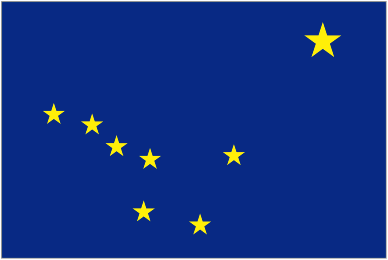
However, Alaska wanted its own flag, and a competition was launched across Alaska amongst schoolchildren. The winning design came from Benny Benson, a 13 year old boy who lived in an orphanage. Most designs featured elements included on the seal. Benny's design was inspired by a constellation of stars he looked to every night before going to bed.

The flag  is a blue field, with gold stars. The blue represents the night sky as well as being the colour of the Forget-me-not, a common flower in Alaska. The constellation he used was the Big Dipper, with the North Star. The Big Dipper represents the bear, the state animal. Also, the North Star represents the future of the state as well as representing the state itself, as the most northerly in the Union.

The flag itself was formally adopted on May 2nd, 1927. With Statehood, it was decided to keep the flag. 

Alaska is unique among the states in that the official state song talks about the meaning behind the flag. Marie Drake, an employee of the State's education department, composed a poem in 1935. This slowly grew in popularity, and Elinor Duseberry set it to music in 1938. It was adopted in 1955, and became the official state flag in 1959 with statehood. 


Thursday, October 27, 2011

Alabama


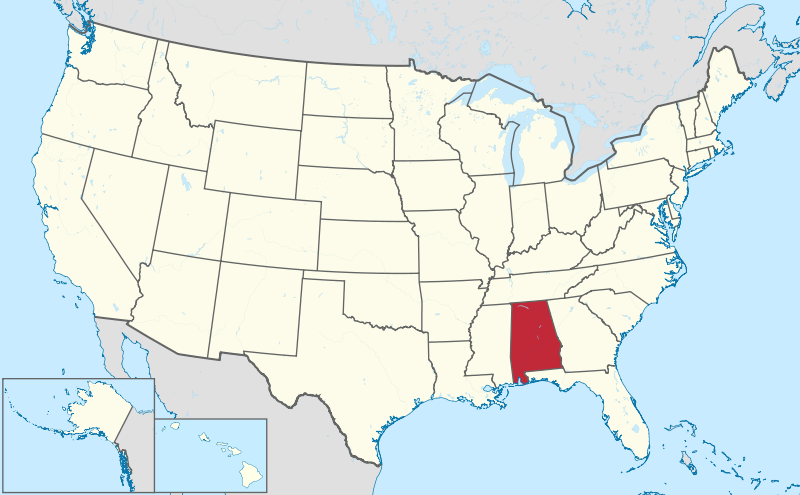
Alabama was first settled by Europeans with the arrival of the French in 1702, and under French control until the 1760's, when it became part of British West Florida until 1780, and then for 90 days, part of the independent Republic of West Florida.

The Republic of West Florida grew out of the American and British settlers who resented Spanish control, and the slowness of negotiations between the Spanish and Americans. A revolt led to the raising of the "Bonnie Blue" flag, which became the flag of the new republic. A simple white star on blue.


However, America annexed this new republic 90 days later, and the territory is added to the territory of New Orleans, before finally being added to the territory of Mississippi in 1812.

Alabama attracted many people due to the fertile lands, and finally achieved full statehood when it became the 22nd state when it was admitted to the Union in 1819.


However, in 1861, Alabama left the Union and became one of the founding states for the new Confederate States of America. Whilst Alabama did not directly suffer from the ravages of war, it did send 120,000 to fight. After the Civil War, Alabama was finally admitted back into the Union in 1869.

Historically the state heavily relied on agriculture, mostly cotton. Something grown on the backs of slaves (I am not going into race issues here). Today, however, agriculture has declined, to be replaced by aerospace, mining, health care and banking.

Most US states dont have a coat of arms, by a Great Seal. Alabama's first seal was introduced in 1817 when it was the Alabama territory, and was the first seal for Alabama upon statehood in 1819.

The first seal was a roundel featuring a map of Alabama pinned to a tree, and showing the states major assets. Its rivers. In the background you can see a riverboat.


After the civil war, a new seal was adopted with the re-admittance of Alabama into the Union in 1868. It features a ring around the seal with "Alabama" written in the top, and "Great Seal" underneath. In the centre is an American Bald Eagle alighting on a national shield. In its left talon, it holds 3 arrows. In its beak is a ribbon featuring the phrase "Here we rest."


Then, in 1939, at the request of the Governor at the time, a new seal was designed, bringing back the concept of the map. The new seal featured the map of Alabama in gold in the centre featuring the states major rivers.


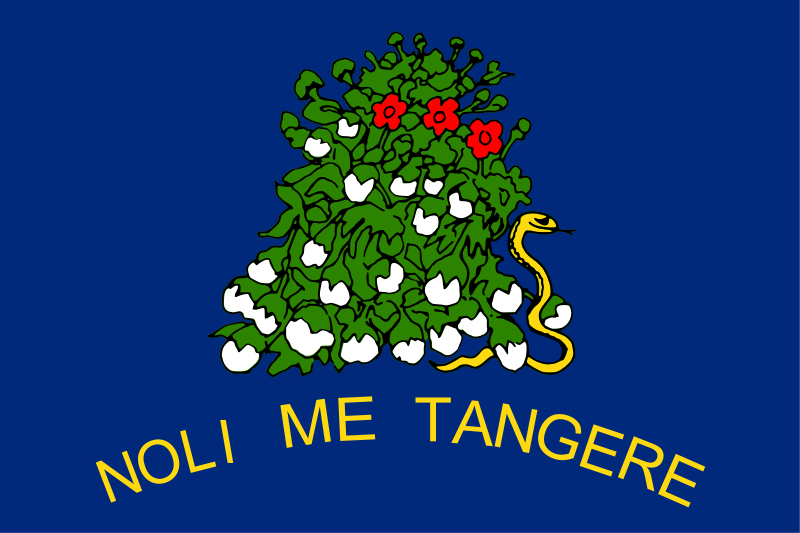
However, Alabama introduced an official flag much later, with the first official flag being introduced in 1861. The first flag was plain blue, but featuring different images on either side. 

On the obverse side, it featured the Lady of Liberty, holding an unsheathed sword in her right hand, and a flag in her left. The flag features the states name in gold on blue. In an arch over the Lady, it featured the words "Independent now and forever."


On the reverse, a cotton plant (from which the state derived most of its income) and a coiled rattlesnake. It also features the phrase "Noli et tangere" in Latin. Meaning "Touch me not."


The current flag was introduced in 1895, and is a crimson St Andrews Cross on white. However, there is some debate of the ancestry of the flag. The flag of Alabama is sometimes depicted as square.


This may come from the fact that many suggest that the Alabama flag was inspired by the blue cross on the crimson Battle Flag of the Confederacy. 


Another possibility, and more likely, is that it comes as a descendant of the Spanish Cross of Burgundy which was in use at the time.


This does seem more likely, given that Alabama was part of the Spanish empire for a time, and the flag remained in use well into the 1800's.  


Yukon


Yukon is roughly shaped like a right angled triangle, and borders the American State of Alaska in Canada's north west. The Yukon was formed out of what was left of the territory controlled by the Hudsons Bay Company after it was divided up once the Canadian Federation took control. The Yukon is sparsely populated, and its environment is arctic or sub-arctic. This means that it has long, cold winters. Also, it has a short summer. However, there is little precipitation.


European explorers first arrived in the 19th Century, slowly trickling in on the hunt of new sources of fur. These new trading routes, and the establishment of trading posts by the Hudsons Bay Comapny actually reached well into Alaska at the time. However, nothing was done to expel them, as Russia did not have the ability to push them out. However, the Hudsons Bay Company WAS forced back into Yukon proper in 1869, when the Americans purchased Alaska from Russia.

Tensions did begin to rise between America and Canada with the discovery of gold in Yukon. The Americans sent a US Army Lieutenant Frederick Schwatka down the Yukon to survey for gold. This so alarmed Canada that they sent their own survey mission in response.

In 1896, Yukon saw a massive population explosion, and saw the Yukon formally created out of the Northwest Territories. 1896 saw the discovery of gold, and the initiation of the Klondike gold rush, which saw a massive leap in its population as people rushed to win their riches. So concerned by the influx of Americans, the Canadian government created a new territory to handle the influx, and better control the situation. The population jumped to just over 27,000. A number the territory would not see again until 1991.


By the 1920's, with the end of the gold rush, the population dropped back to just over 4,000. And remained static until the 1940's. This is despite the growth of other mining opportunities, and a mini-spike in the price of gold in the 1930's. A lot of it is due to the inhospitable nature of the Yukon. Just getting there was very tough. As well as the arctic temperatures.

During this time, Yukon was effectively directly controlled by the Canadian government, and the elected government consisted of just 3 people. However, the territory finally opened up in the 1940's, when as part of the war effort to move raw materials from the Yukon and Alaska, the Alaskan Highway was constructed.

This, as well as further highway construction led to a mining boom through the 60's and 70's with further metals being discovered and mined out. However, today, mining is NOT the biggest sector. It is the government. In order to help with employment, the Canadian government has shifted many functions to the territory.

Also, Yukon has a significant tourism sector, as well as hydroelectricity.

Yukon, being so sparsely populated, and with little by why of government for a long time, did not have its own iconography. So, the Yukon finally got its first coat of arms in the 1950's and was designed by Alan Beddoe, a heraldry expert. 


The shield proper is divided into 2. The lower half is divided into red and blue, with 2 red triangles pointing up. They are divided by a thin white line, in order to follow the ancient heraldic law of not allowing strong colours to touch. The red represents the mountains. Each mountain features 2 gold disks, representing the area's mineral wealth. 2 wavy white lines run down the centre representing the area's rivers.

Above this is a red cross on white, the Flag of England. The flag i defaced by a disk. The pattern on the disk is called "vair" or a heraldic squirrel fur. This represents the territory's history with the fur trade.

The crest is an Alaskan Malamute dog standing on a mound of snow, and surrounded by a wreath of Fireweed, the floral emblem of the Yukon.

Initially, Yukon used a Royal Blue ensign as its flag, with the shield (stripped of its supporters) placed in a white shield on the fly. 


However, a new flag was commissioned in 1967 as part of Canada's 100 year anniversary, and a final choice was unveiled a year later.

The flag itself is a tricolour, defaced with the territory's coat of arms placed in the centre. The tricolour consists of 3 stripes. Green, white, and blue.

The green represents Yukon's forests, the white represents the snows, and the blue represents the lakes and rivers of Yukon.


Thursday, October 13, 2011

Saskatchewan


Saskatchewan was first explored by Europeans in 1690, with Henry Kelsey sailing up the Saskatchewan River in the hopes of trading for furs with the natives. The first settlement in the territory was established by the Hudsons Bay Company in 1774. This was led by Samuel Hearne.


The shape of Saskatchewan began to take shape in 1803, when the US went through the Louisiana Purchase. This saw the US buy a vast tract of land previously countrolled by France. This land ran from the Gulf Coast all the way up to the border with British Canadian territory. This was followed up in 1818 with what essentially amounted with a territory swap between the US and Canada. This swap allowed the border between the two to stretch in a straight line from the Great Lakes, west. 


All this territory fell under the initial control the Hudson Bay Company. However, the new Canadian Confederation took control of the Hudson Bay Company territory in 1870. However, when Canada took control, they where not initially able to effectively exercise control, and the native Metis people rose up in revolt. The North West Rebellion (1885) occurred because the Metis people did not feel that the Dominion had effectively addressed their concerns as a native tribe.

 This did, however, give Saskatchewan one of its early flags. A simple infinity symbol on either blue, or red.


Canada also ran the risk of losing the territory to the US. At the time, the US wanted to seize and control more territory, and with Canada taking control from the Hudson Bay Company, effective federal control took time. And the fear was that the US would try to step into the vacuum.

However, federal control was established with the North West Police enduring the "March West" which saw Canada establish its control. Further control came about with the construction of the Canadian Pacific Railway. Construction of this linked Saskatchewan with the rest of Canada, as well as preventing British Columbia from considering a move to the US.

Thanks to the railway, the population in Saskatchewan exploded with new settlers being granted a small area of free land. The population grew, and by 1905, Saskatchewan became a province in its own right.

The following year, Saskatchewan was granted its coat of arms. The central shield uses the provinces colours of red, green, and gold. On the gold is a red lion passant. A representation of England, the provinces initial territorial governors. On the green, the 3 gold wheatsheaves represents the agriculture of the province. A major industry.


The rest of the coat of arms, the golden helmet mounted by a beaver, which is Canada's national animal. The beaver is holding a Western Red Lily. This is Saskatchewan's flower. The supporters are a royal lion, and a native white tailed deer. Both are wearing native people's beadwork. Suspended from the beadwork is a badge, the Order of Saskatchewan. The coat of arms gained its surrounds in 1985.

In terms of flag, there has been some debate over whether or not the province used a Red Ensign. It is believed, not. However, in 1964, a competition was launched to commemorate the Provinces upcoming 60th anniversary. As part of the design brief, the competition instructed that the major colours of the coat of arms should be used to design the flag.

The flag itself was a horizontal bicolour of green and red. The green representing the fields and agriculture, the red representing the fires that ravage the prairie at regular intervals. On the staff side of the flag is a stylized gold sheaf of wheat. Place on the red stripe on the fly side is the shield taken from the coat of arms. 


The flag was officially unveiled in 1965, and its use was extended into 1967 for the Centennial celebrations. Whilst this flag was used widely, it was never the "official" province flag. Though its supporters hoped it would be.

However, after a province-wide competition, a new, official flag was raised in 1969. It shared some similarities with the unofficial anniversary flag. The new flag was also a bicolour, and featured the shield. As well as an example of state horticulture.

The flag features green and gold colours as its base. Green on top, gold underneath. The green represents the forests in the north, and the gold represents the fields of wheat in the south.


The shield is place in the upper canton on the hoist side, and a western red lily, the province flower, is placed on the fly side.


Tuesday, October 11, 2011

Quebec


Quebec is Canada's largest province by area, and the only province in Canada which has French as its official language.  The first Europeans to arrive in the area that now makes Quebec where Basque (an area now split between France and Spain) whalers and fishermen. 


The French tried to start colonies in the area from the early 1500's, but none met with success. However, French fishermen where regular visitors. However, in 1608, Quebec city was founded as a trading post with the locals, with the locals trading furs and other goods for French made products, such as metal items, like tools and weapons.

As the French spread out, the French government took to naming the region New France. However, its population remained low. In order to keep control, the French government limited immigration into New France to French Roman Catholics. This then prevented anyone of any other religion from settling.

The New France government began to take tougher measures to expel British traders as they moved down the St Lawrence river. This led to tension, and ultimately, conflict. By the late 1750's, full conflict had broken out, and the 7 Years War was being fought between Britain and France all round the world. Ultimately, France lost.

The 1763 Treaty of Paris ceded the northern New France territories to Britain, and the southern territories to Spain. Apart from a few islands, France had now been removed from continental North America. By Royal Proclamation in1763, Britain's new Canadian territory was renamed to Quebec.

Unrest in Britain's American colonies led to a rise in concern that the French Canadians in Quebec would also rise up. This led to the Quebec Act in 1773, which laid the foundations for Quebec to maintain a unique status amongst the other provinces that would eventually make up Canada.

After the American Revolution, many Loyalists moved north into Quebec. However, they where not happy with the Quebec government, still being patterned on French lines. Also, with education and linguistics also being dominated by French. The English loyalists demanded changes. 

However, unwilling to make changes, the decision was made to split the populations. The French Canadians lived round the cities of Quebec and Montreal. In the West. So, the newly arrived English where awarded land in the territories east. This territory would eventually split away and form Ontario.

Confederation came about on the back of the British North America Act of 1867. This led to New Brunswick, Nova Scotia, joining a newly split Quebec and Ontario in forming the start of the new Canada.

Today, Quebec maintains a unique status in Canada, with its own French style of government, an French as its official language. Nationalism plays a huge part in Quebec. So much so that in 1995 a referendum on breaking away from Canada failed. But only just.

Today, independence less of an issue. Unity is preferred by just over 50%, whilst independence by mid 30% of the population.

The Coat of Arms for Quebec where adopted in 1939. This new Coat consists of a shield split into 3 parts. The top third is blue, with 3 fleur di lys representing France. The central stripe is red with a Gold lion, representing Britain, and the bottom is gold, with 3 green maple leaves representing Canada. The shield is then topped with a Tudor Crown. 


However, the first one, granted in 1868 was very slightly different. It did not feature a crown, and only had 2 fleur di lys. This time, blue on gold.


Quebec had been using the Canadian Red Ensign, as well as a deeply unpopular Blue Ensign which, given many peoples French history, did not sit well with Quebekers.


So, a push was on to design a unique Quebec flag. In 1902 the first popular one, the Carillion flag, was raised. A White cross on blue, with 4 gold fleur di lis placed in each corner pointing inward.


In 1947, an independent legislative member pushed hard for a new flag to replace the Blue Ensign which had never been used. Burroughs Pelletier had been asked to put forward some proposals, which he did. Most of which where a variation on a white cross on blue, with elements from the Coat of Arms.


None where used.

However, he did stay around to give advice. Finally, in 1948, a new flag was revealed. This was remarkably similar to the Carillion Flag. It had a white cross on blue but rather than gold fleur di lis, it had 4 white fleur di lis, one on each blue quadrant, and all pointing up.

Contrary to popular belief, the white fleur di lis are not taken from France, which used golden ones, but the white was taken to represent purity.


The flag itself is very popular, and has been ranked as the top, or one of the top flags representing a state in North America. It also provided the inspiration for the Quebec Nordiques Hockey team, which took the same shade of blue, white stripes, and fleur di lis and incorporated them into their uniform.