Sunday, November 13, 2011

Delaware


Delaware. The second smallest state within the US, just above Rhode Island. It is, however, the oldest state in the Union, being the first to ratify the new US constitution after the Revolutionary War, thus earning it the moniker of "First State." This does afford the state a prime position in major US events, such as Presidential inaugurations!


The territory that was to become Delaware was first claimed by the English, in 1597, but it was the Dutch in the very early 1600's who first settled in the area, swiftly followed by the Swedish. However, the Dutch swiftly took control of the Swedish colonies, only to be forcibly removed themselves by the English in the 1660's!

Initially the counties that will go on to be Delaware where placed under the control of James the Duke of York's New York colony. However, William Penn who controlled Pennsylvania wanted access for his lands to the sea, and ended up being awarded the three southern counties on the western bank of the Delaware.

Penn also inherited various competing border disputes between the southern counties, and Baltimore. This was only finally sorted until the drawing up of the Mason-Dixon line in 1763. This line would form parts of the border between the current states of Delaware, Maryland, West Virginia, and Pennsylvania.


A slight problem with this line was where it met the "12 mile circle" which was drawn round the city of New Castle, which was initially drawn up when the city of New Castle was kept out of Pennsylvania. However, when Penn pressed his case for access to the sea, he ended up with New Castle, and its 12 mile circle.


The Mason-Dixon Line intersects the circle on its north-south line, thus creating the anomaly which later became known as The Wedge. A tract of land split between Delaware, Pennsylvania, and Maryland. The Wedge ended up under control of Delaware, and formally incorporated into Delaware properly in 1921. Pennsylvania claimed it as it fell outside the 12 mile circle, and on the Pennsylvanian side of the Mason Dixon Line. Delaware claimed it as Pennsylvania's border was not supposed to be below the 40th parallel. Delaware won its case.


During the Revolutionary War, Delaware did not join in with great enthusiasm, with the locals still having strong links with Britain. However, forseeing the Declaration of Independence, Delaware declared itself separate of Britain, and of Pennsylvania. Establishing itself as a "new" state of Delaware.

Come the new American Constitution, Delaware became the first state to ratify the document, formally becoming the first state to join the new Union. Indeed, during the Civil War, despite being a slave state, Delaware decided to stay with the Union forces. This led to the governor at the time to declare that Delaware where the first in, and would be the last out!

The seal was formally adopted in 1777, just after the Revolutionary War, and has remained largely the same ever since, with minor alterations. The last tweak took place in 2004.


The seal consists of the state coat of arms, and wrapped round with a disc bearing the text "Great Seal of the State of Delaware" as well as 3 dates. 1704, 1776, and 1787. 1704 is when the three counties established their own assembly, 1776 is when they declared themselves to be an independent state, and 1787 is the date of when Delaware ratified the new American Constitution.

The coat of arms is a shield of red, blue, and white stripes. On the red stripe is hay, and a cob of corn. Both are taken from the arms of Kent and Sussex counties, and represent the agricultural success of the state. The blue stripe represents the Delaware river, on which the state depended for much of its trade, industry, and communications. On the white stripe is an ox standing on grass. This represents the extensive animal husbandry in the state.

On top of the shield is a sailing ship, which represents the ship building industry in the city of New Castle, as well as the fact that Delaware is a coastal state.

The shield is supported by a farmer holding a hoe, representing the importance of agriculture in Delaware, and a militia man, representing the central role of the militia in defending America. 

The motto of the state, Liberty and Independence, is carried on a ribbon wrapped round the bottom of the shield.

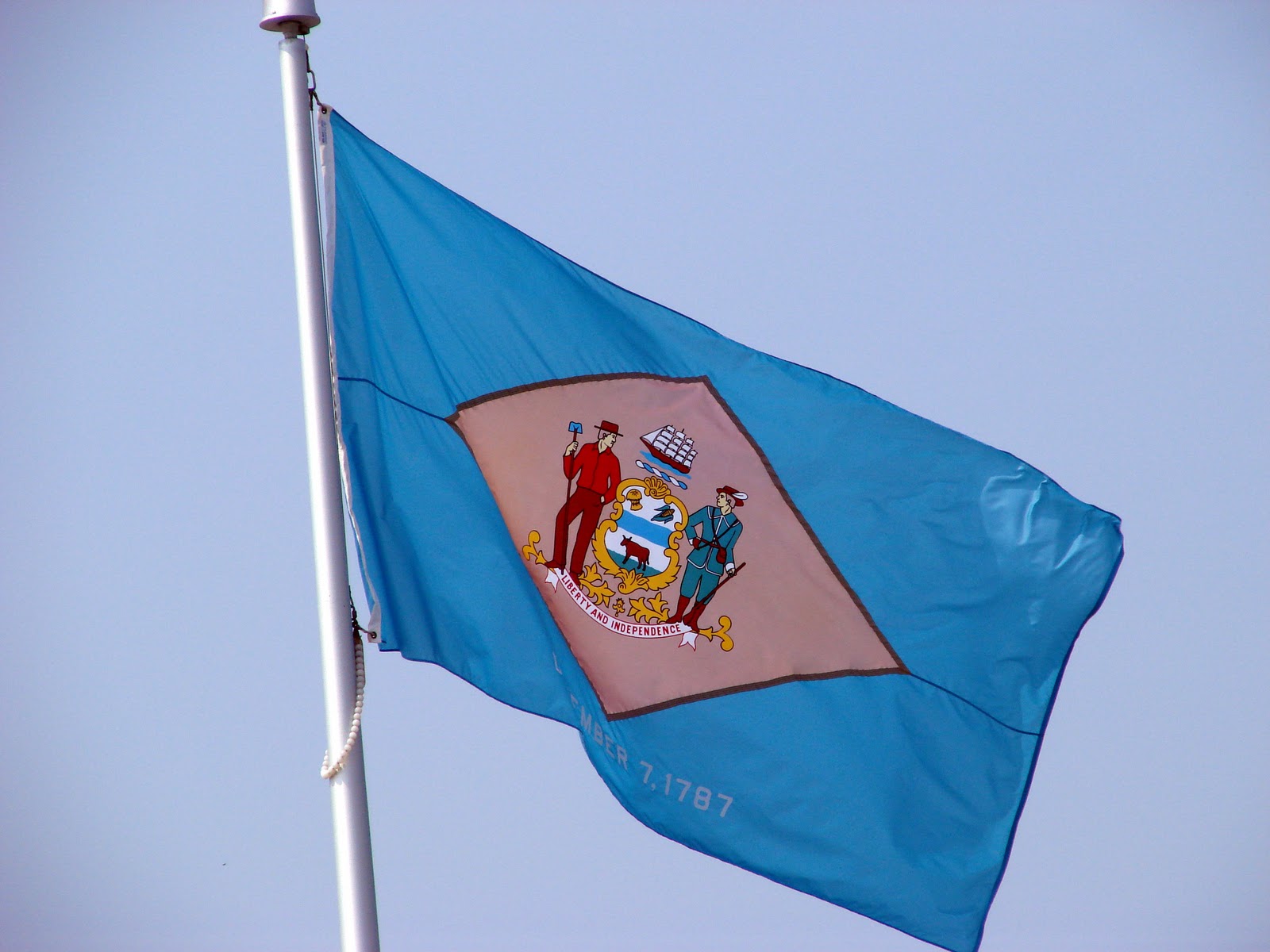
During the American Civil War, units from Delaware fought under a flag of blue, emblazoned with the state coat of arms. The current flag was adopted in 1913. 

The current flag is a field of colonial blue, with the state coat of arms emblazoned on a buff-coloured diamond. Under the diamond reads the text "December 7, 1787" Which is the date when Delaware ratified the new Constitution. The colours themselves reflect the colours from the uniform of George Washington.

Thursday, November 10, 2011

Conneticut


Connecticut is one of the oldest, and smallest of the states within the US. The name "Connecticut" is an Anglicized version of the Algonquian word "quinatucquet," which translates to "upon the long river." The first Europeans to explore was the Dutch, who explored up the river in 1614, and a fort was established up the river, on the site which is present-day Hartford.


Very soon after, the English arrived in 1633, with Puritan settlers moving up from Massachusetts to settle in Windsor, with a large block of settlers arriving 3 years later.

However, borders between English settlements, and the Dutch territory of New Netherlands where not fixed, and the cause of many arguments and skirmishes. 

These borders where not fixed until the Hartford treaty of 1650, but not ratified back in England.  Indeed, England harboured the ambition to unify all the territories in the New World under one government. Namely theirs.


The treaty held until 1652, when war erupted between England and the Netherlands. Conflict in the Americas rumbled on until 1664, when the Duke of York finally took control of all Dutch lands, and took control of New Amsterdam (todays New York).

The borders for the state where settled on three sides with the granting of its Royal Charter in 1662, which essentially gave it a strip of land across the whole of continental America, from the east coast to the west. Connecticut 


However, a lot of the lands where ceded back to the Federal Government post Revolutionary War in return for the Federal Government shouldering Connecticuts debts incurred during the war. Connecticut did settle some of the lands it retain after handing over large portions of it, but finally surrendered control of all of these lands in 1800, taking the state down to the borders it has today.


The first seal for the state arrived in 1639, and was initially the seal for the Saybrook Colony, but was handed over to the Connecticut colony when they purchased the land of Saybrook in 1644. On it where 15 grape vines.


It remained the seal until 1687, when Sir Edmund Andros took control of the colony's government, and the seal vanished.

In 1711, a new seal was commissioned by the colony's government. This new seal reduced the number of vines to three. Possibly to represent the original 3 colonies. Connecticut, Saybrook, and New Haven. It kept the motto, but added the latin text, "Sigillum Colonae Connecticutensis" which translates to Seal of the Colony of Connecticut. It was also made more oval in shape.


The seal underwent its final alteration to the seal seen today in 1784, when after the Revolutionary War, Connecticut was no longer a colony. So, the "Colonae" was removed, and replaced with "Reipublicae" or "Republic."


The first flag to fly over the area was that of the Dutch, defaced as it was with the initials GWC. The initials of the sponsoring company for the first explorers. 


However, Connecticut did not have its own flag until 1895 (not in any hurry!) when a simple blue banner was defaced with a coat of arms inspired by the state seal. The three vines from the seal are placed in the centre of a shield in the baroque style. Meaning shaped with lots of curves. Below the shield is a ribbon carrying the state motto "Qui Transtulit Sustinet." Which translates to "He who is transplanted still sustains." The flag was formally adopted in 1897.


Colorado


Colorado. Named after the Colorado river that runs through the state, named by the Spanish after the red silt that is carried along the river. Colorado is one of three states within the US that have no natural borders. It is, effectively, a rectangle shape. Apart from coastline, Colorado boasts all types of terrain. Deserts, plains, mountains, and canyons.

The territory that is now Colorado had been settled by Indians for thousands of years. However, the first Europeans where the Spanish, who explored the area in 1598, but it was not until 1706 that the Spanish formally laid claim to the territory. Then, finally, in 1787 the Spanish tried their first settlement, but it quickly failed. 

The Spanish never really pushed to settle in Colorado, but did visit, to hunt, and to trade with the native Indian tribes.

Later, in 1803, the United States gained a claim to the eastern half of the current state of Colorado through the Louisiana Purchase. The US finally sent an expedition into the territory to explore in 1806, only to see it arrested by the Spanish, and expelled from the region, given that the Spanish still laid claim to large areas, disputing the sale.


In 1819, The US ceded its claims to the western half of Colorado by the Adams-Onis Treaty. This was signed with Spain to solidify its borders. Some areas on the US' western border area where handed back to Spain. In return, The US gained Florida from Spain, as well as taking over Spains claims to Oregon.


The US finally gained control of all the territory that now makes up Colorado after the Mexican-American War, which ended in 1848. The treaty forced Mexico to cede all its northern territories. For the next 2 years, the territory was unorganised, finally, in 1850, the US senate created 2 new territories. The territories of New Mexico, and Utah.


Then, the rest of the territory was organised in 1854, with the creation of the Nebraska and Kansas territories. These 4 territories all met in what is now Colorado.


The Pikes Peak Gold Rush began in 1858, and saw well over 100,000 people moved to the area. The gold rush only lasted for a few years as river gold was quickly panned, and the shallow seams of gold were soon mined out. The deeper seams proved tough to mine, and high in sulphide, making it hard to extract and purify. The gold rush petered out. However, the problem of the sulphide was soon fixed and led to gold mining becoming a major industry.


In 1859, the gold miners sought to try to set up their own territory, the Territory of Jefferson. This would have been the same shape, but larger than the current state of Colorado.


However, it got nowhere. In 1861, the Territory of Kansas was shrunk, and admitted to the Union. The haste was driven by the secession of the southern states and the establishment of the Confederate States of America in 1860.

With the admittance of Kansas, it left the territory left as unorganised, so the US moved quickly to establish the free (non-slave) territory of Colorado. Just 30 days after the admittance of Kansas. This territory took the same borders that the state has today.

Colorado saw a drop in its population as gold became harder to get, and as a result as people headed back to their home states to fight in the Civil War. However, Colorado was not without a fight. Despite having strong leanings to support the south, Colorado stuck firmly with the Union. Indeed, seeking to disrupt mining, Texas sent a force north through New Mexico. Only to be stopped at the border. Colorado never was attacked again for the rest of the war.

After the Civil War, a movement began to push for statehood. It got so far as the Admission Act in 1865 being passed by Congress, only for the President to veto it. For the next 11 years, one side or the other would support the act, only for movement to grind to a halt.

Faced with a declining population, many businesses pooled their money to find an extension to the Transcontinental Railroad. This connected Denver, making access to one of America's highest cities a lot easier. Also, this was beautifully timed with the discovery of major silver deposits sparking a silver rush to the area, as well as a major gold find at Cripple Creek.

Finally, in 1875, the Admission Act was passed, enabling Colorado to be admitted to the Union as the 38th state on August 1, 1876. Just 28 days after the Centennial of the US, earning the state the moniker of "The Centennial State."

The seal of Colorado was adopted in 1861, upon the creation of the Territory of Colorado, and has remained unchanged ever since, apart from the amendment of the date from 1861 to 1876 and altering "Territory" to "State" as Colorado was admitted to the Union.


At the top of the seal is the Eye of providence, within a triangle, with rays spreading from both sides. Underneath is the Roman Fasces, laid horizontally. It is a bundle of birch rods and a battle axe bound together with a red, white, and blue ribbon. On the ribbon is inscribed Union and Constitution. The bundle of rods represents strength in unity, and the axe represents power and authority.

Below the scroll is a heraldic shield. Across the top, on a red background, are 3 snow-capped mountains with clouds above, and below are 2 miners tools, the pick and and a sledge hammer, crossed. Both placed on a golden ground. Below is inscribed the motto, which in Latin translates roughly as "nothing without providence," or "nothing without the Deity."

The first flag was not introduced until 1907, when the state took a plain blue flag and placed the seal in the centre, removing the red ring surrounding the centre motif. This flag lasted until 1911 when a competition was held to create a new, unique flag.


Andrew Johnson created the new design, which was a flag with 3 horizontal stripes of blue, white, and blue. A gold disk was placed off-centre in the central white stripe towards the hoist. A red "C" was wrapped round the gold disk. The red C was placed within the white stripe.


In 1964, the state introduced new rules, stating that the gold disk should be the same width as the central white stripe, thus making the red "C" overlap the top and bottom blue stripes.

The blue is to represent the skies over the state. The white representing the snow-capped mountains. The yellow represents the sun that shines for extended periods over the state, and the red represents the red coloured earth in the state.

The flag has proved popular, to the point that it has been incorporated into the states highway markers.


As well as being incorporated into the main logo for the (now defunct) Colorado Rockies NHL Hockey team!


Monday, November 7, 2011

California


California. The third largest by land, and most populous of the states. Also, it has the largest economy in the US, accounting for 13% of the US. also, if California where an independent nation, it would rank 8th in the world on its own.


The fist Spanish explorers popped up in California in 1533, and later in the 1540's via the Pacific. The whole of northern Mexico into what is today the US state of California where combined as one large territory. However, the area that makes up todays California did not see any large immigration from new settlers. Indeed, due to California being ringed by its own natural barriers (Mountains on 2 sides, deserts, and the Pacific) the Indian tribes developed quite differently to those outside!

There was no huge wave of immigration because the only reliable way to enter was via ship. Unfortunately, that meant sailing from Mexico against the powerful California Current. Which made a journey into an easy 30 -40 day trip.

In 1821, Mexico gained its independence from Spain, and took control of California. However, due to its isolation and low population, California did not contribute tax to the new and unstable Empire. Also, with the lack of control, the Californios engaged in illegal trade after they had begun to develop a growing tallow and hide industry. However, soon, Mexico scrapped anti-trade laws, and trade rapidly increased. Trade soon reached about a ship a day from Britain and Russia as well as the US. The main port was the city of Monterey, where the paperwork and taxation issues where taken care of.


During the late 1820's, more settlers began to arrive from all over the US and Canada after various trails into California across the mountains had been opened up.

Due to bad mismanagement from Mexico, as well as about 40 different governments in just over 20 years, the new wave of immigrants rose up in revolt, and declared the new California Republic. The revolt took place in 1846, with the capture of the Mexican governor, and the raising of the Bear Flag. 


The Bear Flag was a white banner with a red bar on the bottom. It also featured a gold star and a bear, as well as the wording "California Republic" across the centre. All elements that where later incorporated into the California State flag. 

The revolt lasted just over 20 days, and really did not impact the rest of the state, and came to an end when, in the opening stages of the Mexican-American War, the US marched into California, and took control on behalf of the US. Initially, the US stationed Naval units along the coast as a guard against Mexico, but otherwise took no action to seize control. However, Commodore Sloat was spurred into action with the Bear Flag Revolt, and the arrival of the HMS Sir Collingwood, a massive 80 gun Royal Navy ship of the line. The US Marines took control without a shot being fired.


From 1847, to 1850 the US Military took control of California. A position it did not want as it had no training with forming a government! So, in 1849, a Constitutional Convention was set up after a vote had taken place to elect representatives. It was hardly truly representative, since no true accurate census had been taken up to that point.

Admittance to the Union as the 31st state occurred in 1850, but it was not a straight run thing. With the Mexican - American War, conflict arose in the US senate between the slave states (across the south of the US) and the free states (across the north). As the US had success in the war, problems arose when trying to decide how to organize the territories. The southern slave states wanted slavery to be allowed, whilst the northern states wanted any new territories to be "free."

With statehood came a population explosion. This was driven by the California Goldrush, with the discovery of gold in large quantities across the state. Population growth accelerated further in 1869 once California was connected to the rest of the US with the Transcontinental Railroad allowing easier access. Also, demand for food drove growth. It was discovered that the lands of California proved very fertile and if irrigated, would provide crops all year round.

At the Constitutional Convention, it was decided to adopt a seal for the new state. The seal has remained in use since its adoption with minor alterations.


The seal features the Goddess Minerva, the goddess of wisdom and war. It also features a grizzly bear. The state animal. The bear is eating a vine of grapes, which represent wine production. A sheaf of wheat represents agriculture, whilst a miner represents the Gold rush. The ships represent the the states economic power. The word "Eureka" is the state motto, meaning "I have found it!"

The flag itself was signed in in 1911, and inspired by the Bear Flag from the California republic. It features a red star, which was taken from the "Lone Star Flag" which was raised in 1836, after a revolt by Juan Alvarado, and  Isaac Graham tried to gain independence from Mexico. It failed. 


Also on the California flag is a wide red bar at the bottom, and a bear walking on grass, facing towards the star. The bear itself is the state animal, and modelled after Monarch, a bear captured in 1889. It was the last wild Grizzly in captivity. 


Underneath the bear is the text "California Republic." 


Monarch, upon his death in 1911, was mounted and kept in the Academy of Sciences in Golden State Park.


Saturday, November 5, 2011

Arkansas


The first European to arrive in the territory that is Arkansas was the Spanish explorer, Hernando de Soto. He was exploring the area for gold, as well as for a passage to China, by finding the Pacific Ocean. Unfortunately for him, Arkansas is pretty much half way across the continental US! He still had a long way to go!

It was the early Spanish and French explorers who are the most likely ones to give the territory its future name of Arkansas. Using a phonetic spelling for the name used by the Illinois tribe for the Quapaw tribe of native Americans who lived down river from the Illinois people.

The territory was initially under the control of the Spanish, but eventually fell under the control of France, and became part of a massive tract of land from Louisiana all the way up to the Canadian border, known as New France.


The new United States of America, under the Presidency of Jefferson looked to take control of the port of New Orleans towards the end of the 1700's, already having access to it through treaties with Spain. However, unbeknownst to the Americans, the Spanish ceded the city to France. Needless to say, this upset the Americans, and nearly drove the US into an alliance with Great Britain.

However, the US wanted New Orleans, and began negotiations to purchase the port from the French (even though it had not been formally ceded from Spain to France at the time). Napoleon, despite legally being unable to do so, opted to sell all of the Louisiana territory. Apart from New Orleans, the land was worthless to him. Also, he needed the money. In 1803 war with Great Britain was looming, and France had lost the revenues generated from the sugar plantations of Haiti, after the worlds first successful slave revolt.

So, with the ratification of the purchase in 1804, the US effectively doubled in size.

Initially, the new land was organised into territories, with the future state of Arkansas being located in the Louisiana Territory. This was incorporated in 1805, and was re-named as the Missouri Territory in 1812, with the admittance of Louisiana as a state.


All lands south of the 36th parallel was split from Missouri Territory in 1819, and this became the new Territory of Arkansaw (spelling to change at a later date!)


However, the Territory was split in half, the land splitting away eventually to become the US state of Oklahoma. This occurred in 1824, with further lands being split away in 1828. This final split would leave Arkansas with the borders in use today.

Arkansas was formally admitted to the Union as the 25th state in 1836, and as the 13th slave state. Almost immediately, Arkansas played a significant role in US history, as the state supplied man and arms to Texas as that state rose up in rebellion against Mexico.

When the Confederate States of America was formed, Arkansas refused to leave the Union and join the new nation. However, once President Lincoln had called for troops to attack the Confederacy, Arkansas announced it was withdrawing from the Union, and joined the Confederacy in 1861.

After the CSA was defeated, the United States took control of the former Confederacy states, and slowly readmitted them to the Union, with Arkansas being readmitted in 1868. This time with a new constitution. Under the constitution, it promised universal suffrage. Unless you where a former Confederate. In which case, you where disenfranchised.

Following the Brooks-Baxter War during which 2 Republicans quite literally went to war for the governorship. In 1874, in order to garner support, former Confederates where re-enfranchised by Elisha Baxter.

Arkansas has also been on the front line in the US for race relations, with the Ku Klux Klan having played a significant role in the state, and with the "Little Rock Nine." Nine African-Americans who wanted to enroll in a white school, who had been given the right to do so once the courts had decided that segregation was illegal.

Following the States departure from the Union, in 1864, the state brought in its first seal, which was modified to its current form in 1907.


In the seal it features the Angel of Mercy, Goddess of Liberty, and the Sword of Justice. The three are surrounded by a Bald Eagle. In its beak it holds a ribbon bearing the state motto of "Regnat Populus." Translating as "The People Rule."

On the shield on the Eagles chest is a steamboat, plow, beehive, and a sheaf of wheat. All symbols of the states industrial and agricultural bounty.

In 1912, Arkansas sponsored the construction of a ship for the US Navy. However, with construction nearing the end, it was discovered that Arkansas did not have a state flag to present to the new ship. So, a contest was hurriedly organised, and won by Willie Hocker.

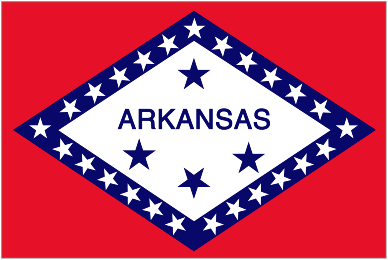
Her initial design was a red flag, with a white diamond edged with a blue stripe placed in the centre. He placed 25 white stars within the blue stripe to represent Arkansas as the 25th state within the Union. Then he placed three blue stars in a line across the centre of the diamond. The three stars have several meanings, including the fact that Arkansas was the third state created out of the Louisiana Purchase, and the three nations to which Arkansas has belonged to. Spain, France, and the US.


The diamond shape itself also has meaning. At the time of the flags design, Arkansas was the only state within the Union with active diamond mines. There have, however, been further discoveries of diamonds in Colorado and Montana.

This was the initial, however, at the request of the flag committee, Hocker altered the design to her flag, including the word "ARKANSAS" through the centre of the diamond, and moving the three blue stars to 1 above, and 2 below the name. Changes duly made, the flag was adopted in July 1813.


A further change was made to the flag in 1923, when it was decided to add a fourth star to represent the states inclusion (albeit briefly) within the Confederate States of America. This new flag was adopted in 1923, with 2 stars above, and 2 below the word "ARKANSAS."


Then, the final change came through in 1924, which saw the original three stars relocated to below the "ARKANSAS" and the star representing the Confederacy placed above.

A final amendment came through recently, in 2005, with the colours of the flag being fixed. The red and blue are now described as "Old Glory Red," and "Old Glory Blue." It has also been decreed that the Governor can only buy state flags made within the US!


Wednesday, November 2, 2011

Arizona


Arizona. One of America's hottest and driest states. It was born out of the Civil War when the name "Arizona" was first used. Before then, it was part of the Mexican state of Vieja California once Mexico declared independence from Spain in 1822. 

However, the Spanish was first in Arizona back in the 16th century. Drawn by the presence of valuable metals. Mostly silver. However, Arizona remained largely unpopulated, with the economy not much above subsistence level, and local small mining concerns.

The Mexican war of Independence heavily damaged the newly independent Mexico, destroying a lot of its silver mining. This forced Mexico to sell off large swathes of land to try to help pay off its debts. It also allowed large numbers of Americans to start to move into the territory and settle. Farming, and trapping. 

In 1836 Texas with a largely immigrant population declared its independence from Mexico. Mexico, still weak, ended up losing and Texas gained its independence. It survived as an independent republic for 10 years, backed by the French, British, and Americans. 

Mexico saw Texas as part of its territory. It was able to 'get by' with Texas as a small republic. Even with Texas pursuing territorial claims. However, in 1846, despite strong objections from Mexico, Texas was annexed by the US. This led to the Mexicans declaring war. The Mexican - American War (1846-48). 

With the Americans marching into Mexico City, they forced the Mexicans to sign the Mexican Cession in 1848. This handed Mexican territories north of the Gila river, and west of the Rio Grande, all the way to California, and north to Oregon. In return, the US paid compensation of $15,000,000 to the Mexican government.


The territorial grab was complete in 1853 with the Gadsden Purchase. Gadsden was the American Ambassador to Mexico, and led the negotiations at the time to push the border south. This final purchase gave the US the land that would lead to Arizona and New Mexico.


This region joined the US as the Territory of New Mexico.

The first time 'Arizona' appeared was during the Civil War. The south of the territory, settled by white farmers with slaves opted to break the south of the Territory of New Mexico from the Union and started the Territory of Arizona within the Confederate States of America. 


The flag of which became known as the "Stars and Bars."  3 horizontal bars of red, white, and red. A Blue square in the upper hoist, with a circle of 7 stars.


However, it was a short-lived state, with the Union recapturing it the following year, and reintegrating it with the Territory of New Mexico. However, 1863 saw a re-birth of Arizona. This time, the Territory of New Mexico was split in two vertically. The western half became the Territory of Arizona.


Throughout all this, farming and mining remained linchpins to the economy. The First World War drove demands for Arizona's raw materials, only to see the economy devastated by the Great Depression. However, with the advent of the Second World War, Arizona again boomed.

Arizona was admitted to the Union in 1912 as the 48th state. However, it nearly entered the Union as part of a larger State of New Mexico. Many saw this as a plan by the Republicans to maintain a grip on power, with New Mexico being strongly Republican. Whilst those in New Mexico voted strongly in favour of this plan, those in Arizona voted strongly against. This then led to Arizona joining later.

The first seal used to represent Arizona was introduced upon the creation of the first territory of Arizona, in 1863. This featured the text "Seal of the Territory of Arizona," as well as the date, and "Ditat Deus" or "God enriches," the state motto. The seal features a bearded miner standing in front of a wheelbarrow, holding a pick and and a short handled blade. Behind are two bare mountains.


However, a new seal was introduced the following year. The new seal kept the text, but changed the images. This new seal featured the San Fransisco peaks, as well as a deer, and cactus. However, it took a long time for the seal to enter into official widespread use. 1879.


It was in 1910 that the state began the process of introducing a new seal. This process was completed with the admittance of Arizona to the Union. The new Seal features a central shield in which are a mountain range in the background with a rising sun. On the right is a water storage reservoir, with a dam, and irrigated fields. Also on the right is a cow, and on the left is a quartz miner holding a pick and a shovel.


This represents the Five C's that are the foundational elements of the economy of Arizona. The cow represents Cattle. The irrigated fields on the left and right represent Citrus and Cotton. Copper is represented by the miner, and Climate by the sun and clouds in the shield.
Arizona's flag was first created in 1910 by Colonel Charles W. Harris for the Arizona Rifle Team. This was because up until then, Arizona had been the only team to go to shooting competitions and not have a flagt o march behind.


The flag he created was formally adopted in 1917 and became the State Flag.


The flag is split into 2 halves. The lower half is blue, the colour of liberty. Placed in the centre of the flag is a copper coloured star. The star represents the state, with the copper colour inspired by the mining industry. Fanning out from the top of the star are 13 rays. These represents the the sunsets of Arizona. There are 13 rays represent the 13 original US states. The rays are coloured red and yellow. The colours of the Spanish flag, who where the original colonists of the area. The blue and red are matched to the blue and red in the US flag.

In 2001, the North American Vexillological Association conducted a poll on the top flages in North America. Arizona's flag came out ranking 6th.