Friday, July 9, 2010

Mayotte


The Flag of Mayotte

The island of Mayotte is located in the Indian ocean, between the island of Madagascar, and the African mainland. It is part of the chain of islands that make up the nation of Comoros. However, Mayotte remains part of France.


The island of Mayotte, and the rest of the Comoros islands had been fought over by various Sultanates through its history, also falling under control of the king of Madagascar.

In 1843, the Comoros islands where ceded to France, until a referendum in 1974. The referendum saw the other islands of the Comoros vote for independence, whilst the island of Mayotte voted to retain its link with France. A follow-up vote in 1976 saw the same result. A desire to retain its link with France.


Since independence, Comoros has maintained its claim to the island of Mayotte.Also, they have pushed the United Nations, where the Security Council has voted many times in support of Comoros, only for France to use its veto. The tenor can be judged by the title of the resolution! "Question of the Comorian island of Mayotte." However, since 1995, the issue has not been raised before the Security Council.

Another referendum in 2009 saw Mayotte vote to abandon its "overseas community" status, and become Frances 101st "departement." This will see Mayotte become fully integrated with France's governmental system. Its current legal system, which sees a blend of French and Islamic laws will be slowly abolished and France's uniform legal code will be implemented.

As part of France, Mayotte does not have its own official flag. It uses the national flag of France. However, Mayotte does have its own unofficial coat of arms. A central shield has a cloud design upon it, with the top half in blue, and the bottom half in red. On the blue, is a sideways crescent, and 2 yellow flowers on the red. The supporters are seahorses, and underneath is a ribbon with the islands motto, "Ra hichiri."


The island has an unofficial flag which is white, with the islands coat of arms placed in the centre. Above, in red capital letters, is the islands name "MAYOTTE."


There is a movement on the island to reunify with Comoros. However, that movement is small, and with the shift in 2011 to becoming a full departement makes it very, very unlikely that Mayotte will move away from France.


Thursday, July 8, 2010

The Republic of Turkey


The Ay Yildiz

The Ottoman Empire preceded the modern state of Turkey, and lasted from 1293 to 1923. At its height in the 16th and 17th centuries, the Ottoman Empire controlled territory on 3 continents.


It controlled territory round the black sea, in the Balkan area of Europe, large swathes of Arabia, and along north Africa.

All though its history, the Empire looked to expand its influence, with regular campaigns into Europe. The Empire reached as far as the gates of Vienna, and parts of Italy. Indeed, the Emperors took to effectively titling themselves as "The Roman Emperor" and saw themselves as legitimate successors to the previous Roman Empire. This saw a concerted campaign to seize the heart of the old Roman Empire, the city of Rome. Whilst they managed to briefly hold parts of Italy, they never where able to get the city of Rome.

The Ottoman Empire did not have a fixed flag, with Emperors using a variety of flags for the state, and as personal banners. One of the earliest in use to represent the Ottoman Empire, was a simple white banner with a gold crescent faced up, with a single bar running through it. This emblem was called the Kayi Tamgha, "seal." This banner was in use from very old times, to 1326.


From 1383 to 1453, a new banner was used for the Empire. A simple red curved triangular pennant.


From 1326, to 1517, the Emperor flew a new flag alongside this pennant. A red banner, with a gold cross. In each canton, he placed a stylised version of the Kayi Tamgha.


After 1453, the Emperor introduced a modified pennant. Keeping the shape and colour previously, but placing a single gold crescent upon it.This banner was in use up to 1844.


The Ottoman Navy used its own version of this pennant, but switching the red for green. This was in use to 1793.


Another banner introduced for the Empire came in in 1517, and was in use until 1844. This new banner was a standard rectangular red banner, with a green oval in the centre. In the centre of the oval, they placed three gold crescents.


In 1843, The Ottoman Empire tried to arrest the slow decline of its Empire by instituting a massive program of reform. The Tanzimat. This saw the secularisation of the state from Islam. Something the modern Turkey has tried to maintain. 

This program sought to bring all its citizens together as Ottoman by guaranteeing all its citizens equal rights. Something that had not happened before, with non-Muslims being treated as second-class. In order to unify the people of its empire, part of the reform saw the introduction of a new flag. This time, a simple red banner, on which is a white crescent, and a 5 point star.


This was the last flag of the Empire, and in use from 1844 to 1923.

The First World War triggered the ultimate demise for the Ottoman Empire. Before the war, the Empire ended up losing a lot of its European territories in the Balkans after campaigns by the people there for freedom.

At the start of the First World War, the Ottoman Empire enjoyed a sequences of success. However, Pressure in Europe, and an Arabic uprising led by Captain T.E Lawrence (Lawrence of Arabia), and backed by the British, proved most successful in pushing Ottoman forces away from the Arabian peninsula. With the ending of the war, the Ottoman Empire was on the losing side. Its territories where divided up, and gained their freedom.


After the war, Britain and France occupied the city of Istanbul in order to force the implementation of a peace treaty, and make sure that the partition of the territories went ahead unimpaired. The occupation led to the rise of a nationalist movement that fought to get the "occupiers" out of Turkey. The end result of this saw the abolition of the Ottoman Empire, the abdication of the Emperor, and the creation of a new, secular, republican Turkey. 

Ever since then, Turkey has had a staunchly secular constitution, whilst the majority of the people are Muslim. This secular society is fiercely guarded by the military and judiciary. And currently sees a lot of pressure rising, with the current Turkish government being accused of pursuing an Islamic agenda.

With the foundation of a new Turkish state, a new flag was brought in. It was decided to keep the last flag of the Ottoman Empire. However, the new flag saw a slightly lighter shade of red used, as well as having the crescent and star being slimmed, as well as having regulations laid down detailing the dimensions of the flag and its component parts.

The crescent was first used as a symbol of the Ottoman Empire as far back as 339 BC, when a waxing moon allowed the people of Byzantium to beat off an attack by Phillip of Macedon. The people where so grateful, they brought in the crescent as a symbol.

The use of the crescent and star has cropped up many times through Turkey's history. Mainly, just when defeat looks likely for the Turks, the Emperor has seen an image of a star and a crescent in a pool of blood. The leader of Turkey is then able to lead his forces to victory!


Monday, July 5, 2010

Martinique


The island of Martinique

The island was initially discovered by Christopher Columbus. However, Spain ignores the island as there where many territories in the "New World" that where of far more interest to them. However, France did settle the island, and by the 1600's, had begun difficult, but lucrative cultivation of sugar cane from the island.


Indeed, in 1636, Louis XIII passes a law allowing the forced relocation of Africans to the Caribbean to work as slaves on these plantations. Also, the French government promoted the island as a land of opportunity and a good life, and encouraged people to move to the island. However, the work was hard, and the island needed a constant flow of immigration to keep the islands development going.

The island grew and developed, and soon was exporting to nearby Dutch and English islands. In 1650, the island took the step to build a distillery to create a second export from the island. Lucrative, but not to the levels of sugar cane. They took the waste from the sugar cane, and turned it into molasses.


The 1700's saw the introduction of coffee to the island to become a third export. However, the French lost the island to the British in 1762. With the ending of the war, there was a real risk that Britain would keep the island, taking the hugely lucrative sugarcane industry for themselves. So desperate to keep the industry, France willingly gave up all territorial claims in Canada, amounting to thousands of square miles, in order to keep Guadeloupe and Martinique.


With the rise of the French Revolution, Britain re-took the island in 1794, though they returned the island back to the new government of France in 1802. Though, the British returned in 1804 and built a small fort, which lasted for 17 months. The British returned again in 1809, and this time, kept the island until 1814. This meant that Britain abolished slavery on the island. With the return of the island to France, Britain forced France to keep the abolition in place, though it really took France to 1831 to fully enact the abolition.

In 1946, Martinique followed its sister island, and became a department of France. This then gave them access to French funding, which was used to replace the destroyed economy which had seen its sugarcane industry devastated by hurricanes. The French funding has resulted in one of the highest standards of living in the Caribbean, though Martinique is still reliant on central government funding.

Martinique as an department, uses the French tricolore flag. However, it does have an unofficial flag. In 1766, a decree was issued that specified that vessels from French islands should use flags based on the French jack, a blue banner with a white cross.


So, the island of Martinique also has its own unofficial flag.


This flag takes the French jack of a blue banner with a white cross, and places a white snake in each canton. The snakes ar Fur de lance Vipers, native to the island, and shaped in an L shape, to stand for Lucia.


Guadeloupe


The flag of Guadeloupe

The island group that is Guadeloupe was initially discovered by Columbus, and it was from Guadeloupe that Columbus brought back the first Pineapple from the America's to Europe. The French then went on to colonise the island, and held the island, apart from brief moments when the British captured it.

Firstly, during the wars with France in the 1750's, when Britain gave the island back in return for France ceding all its territories in Canada, and relinquishing all its claims to Canadian territories. The second came during the French revolution, when the revolutionary government of France commanded that the island freed its slaves. Rather than allowing its slaves to be freed, the islands masters turned to the British. However, the British held the island for only a couple of years until they where forced to leave. After which the slaves where released, and they turned on their masters. In order to maintain control, Napoleon ordered slavery to be reintroduced on the island in 1802.

A third time occurred in 1810, when the British again seized the island, and held it until they handed it over to Sweden, who held the island for a year and a half, until the Treaty of Paris saw the islands returned to France.

Guadeloupe remained as a colony of France until 1946, when it became an overseas department.

The islands natural beauty helps drive its tourism industry, one of its biggest source of revenue.


Though this has been hit in recent years, with natural disasters such as hurricanes, as well as a local strike by workers demanding help with raising their incomes.

The official flag in use on the island is the French tricolore. However, the island does use its own official flag, which consists of a white banner, with an emblem placed in the centre. The logo is made up of a top in blue, representing the sky, the bottom half in green, representing the land. Dividing the square is a black, simplified bird shape, giving the green a hill-like outline, as well as representing the wildlife. Rising over the bird is a rising sun. Under the emblem is written "Region Guadeloupe."


The island also features a small independence movement, led by the Communist Party. This independence movement has suggested a new flag for the island. Bearing a strong semblance to the flag of Surinam, it is a red banner topped and tailed by white and green stripes. Like the flag of Surinam. Placed in the centre of the red stripe, towards the hoist of the flag, it features a gold star. The Surinamese flag also features a star, but placed dead-centre.


The island also features an unofficial flag derived from a coat of arms created to help promote the island. The coat of arms is black, with a green sugar cane plant overlaid with a golden sun. A blue bar is placed over the top of the coat of arms, and features three French fleur de Lys. 


The island has also turned this into a flag, whilst has no official status, it is in use. It is used to help promote the island, and its individuality. Taking the coat of arms, and turning it into a banner form.


A second version takes the same banner, and replaces the black, with red.


Wednesday, June 16, 2010

French Polynesia


Flag of French Polynesia

French Polynesia is an Overseas Collectivity of France located in the South Pacific, made up of several groups of Polynesian islands, most famous of which is Tahiti. The islands where visited by ships from many of the European nations, however, it was during the early 1800's that France sent out many mssionaries to try to convert the local populace to Christianity. However, many missionaries where expelled, which led France to protect the missionaries with a gunboat. Finally, in the late 1830's, France formally took over the territories and turned it into a colony. 

Finally, in 1889, the territory of French Polynesia was formed with the further annexation of several islands in the area. 

The islands became famous post 1962 for having to play host for France's nuclear testing which has left several atolls totally uninhabitable.

Each group within French Polynesia plays host to several groups. Each with its own flag. The flag of the Gambier Islands is a simple white/blue/white horizontal tricolore with 5 stars. 1 blue star in each corner, and a white star in the centre.


The Tuamotu Archipelago has a red/white/red horizontal tricolore with a blue vertical bar on the hoist side. 16 blue stars are arranged within the central white bar.


The Marquesas share some similarities with the flag of the Philippines. A horizontal bicolour with a triangle place on the hoist of the flag. However, the top of the bicolour is  yellow and red underneath. In the white triangle is a stylised image of a mask.


The Austral Islands flag features a central white square bordered by 2 thin red vertical bars. In the centre of the white square is a representation of an island hat in blue, surrounded by 5 blue stars.


For the territory of French Polynesia, the coat of arms consists of a disc featuring a stylised sun and sea. Overlaid with an image of a Polynesian outrigger canoe in red. 


The flag itself uses the emblem of the island and places it in the centre of a central white horizontal stripe. The white horizontal stripe is bordered by 2 red stripes. 


French Guiana


The Flag of French Guiana

French Guiana is an overseas department of France, and is territory held on the north east coast of South America. Termed French Guiana a it was bordered by British Guiana, and Dutch Guiana. However, both those territories have since been awarded independence, whilst France has maintained its hold on French Guiana.

The French originally settled in the territory during the 17th century, and during the 18th century saw France send a large number of people to colonise it properly. However, in 1809, a joint British/Portuguese force seized the territory for the Portuguese Empire. However, in 1814, it was returned to France. 

In the late 19th century, a border dispute rose between France and Brazil, and before arbitration settled the dispute, a pro French independent nation was formed in the disputed territory. Officially termed the Republic of Independent Guyana, it was commonly referred to as Counani. Its flag took the French flag and placed it in the upper hoist canton of a green banner.


Arbitration finally settled the dispute, mostly in Brazils favour. 

The 1970's saw the settlement of a large number of Hmong refugees from Laos, and the rise of an independence movement in French Guiana. However, this movement peaked in the 80's, and has since tailed away.

Economically, the territory is reliant on grants from the French mainland, as there is very little manufacturing, and very little by way of agriculture. Though it does produce a lot in terms of sugar cane and bananas. The Guiana Space Centre which is used by ESA for the launching of its Ariane rockets accounts for another 25% of the territories GDP.


Formerly the territory uses the French tricolore as its flag.

However, the territory also flies its own flag. Before 2010 the territory used a white flag with a logo placed in the centre. It featured a yellow 5 point star on a blue field, with a green field underneath featuring a figure in a yellow long boat riding on orange waves.  Above the logo is written "Guyanne" and "La Region" below.


The shield for the territory is divided into three parts. The top third is blue, and features 3 French Fleur-de-lies, and the year 1643, marking the arrival of the first French. The middle third is red, and features a loaded longboat, and the bottom is green, featuring Guianese flora.


However, in early 2010, the territories government adopted a new flag. A similar design to the flag of pro-independence unions, this flag is a bicolour flag divided diagonally featuring green and red. 


The green represents the forests, and the gold represents the potential mineral wealth of Guiana. In the centre is a red star of socialism.

South Georgia and the South Sandwich Islands


Flag of South Georgia

The islands of South Georgia and the South Sandwich chain are a collection of remote and deeply inhospitable islands in the south Atlantic.There is no native population of the islands, the only population consists of the British government officer, the postmaster, and members of the British Antarctic Survey.

Britain initially claimed sovereignty over South Georgia in 1775, and also claim the South Sandwich islands in 1908.

The island of South Georgia did host a small but semi-permanent population during the 19th century, when several whaling and seal hunting bases where maintained on the island. The first of which was established by Carl Anton Larsen of Norway. He established the community of Grytviken. However, whaling and seal hunting ended in the 1960's, and the bases where abandoned soon after. The community of Grytviken now lies abandoned, and apart from a few buildings which have been preserved...


...sees many of the buildings and various states of decay.


During the 1920's, Argentina laid claim to the island of South Georgia, and then in the 1930's, to the South Sandwich islands. And during the Falklands war, the islands fell under the control of Argentina when a detachment of Argentinian marines took control of the offices of the British Antarctic Survey team by landing on the island posing as scrap metal merchants. 

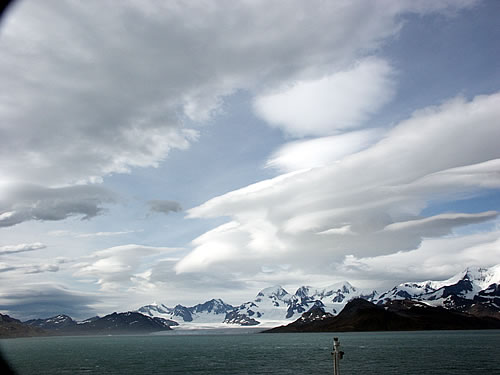
The islands themselves are very bleak and during the winter the islands are covered in snow and ice. 


During the summer, the lands are free from snow and ice up to about 300 metres, where the snow line begins. However, the South Sandwich islands lie further south, and feature far more severe weather.


Because there is no settled population, the vast majority of the income is in terms of grants from the British government. Also, the islands make a lot of money from the sale of fishing licences, as well as the sale of stamps.

Before 1985, the islands where governed directly from the Falkland islands, and then in 1985, the territory of South Georgia and the South Sandwich islands was created, and issued with its own coat of arms. 


The shield features a gold rampant lion holding a torch, representative of the UK, and discovery. The lion is placed on a green triangle, and overlaid a sequence of blue and white diamonds. Taken from Captain James Cook's family arms. The supporters are a seal, and penguin. Animals native to the islands. The crest is a Reindeer, from the 2 herds found on the island of South Georgia.

The flag was also issued at the same time. Like all other British overseas territories, a Blue ensign. Initially featuring the coat of arms within a white disc, in 2002, the flag was altered to remove the disc, and enlarge the coat of arms.